
Federal BOP Release Meaning
No federal prison was identified in Scott County, but a local custody trail may reach the federal system. A federal defendant can be held locally for federal process, transferred under a marshals hold, or later enter a BOP institution. The sending SWVRJA event proves only that regional-jail custody ended. The federal record controls the BOP layer.
BOP may display “Released” or “Not in BOP Custody” with a release date and no facility. That means the person is no longer in BOP custody. It does not rule out custody by SWVRJA, VADOC, ICE, another jurisdiction, or supervision after prison. State the result with that limit instead of converting it into a broad claim that the person is free.
Search Federal BOP Releases
Open the official BOP Inmate Locator. Search by BOP register number or another accepted federal identifier when known. A name search can use optional race, age, and sex fields to distinguish similar results. BOP covers federal inmate records from 1982 to the present.
The official federal locator screen is the source for the BOP status check.
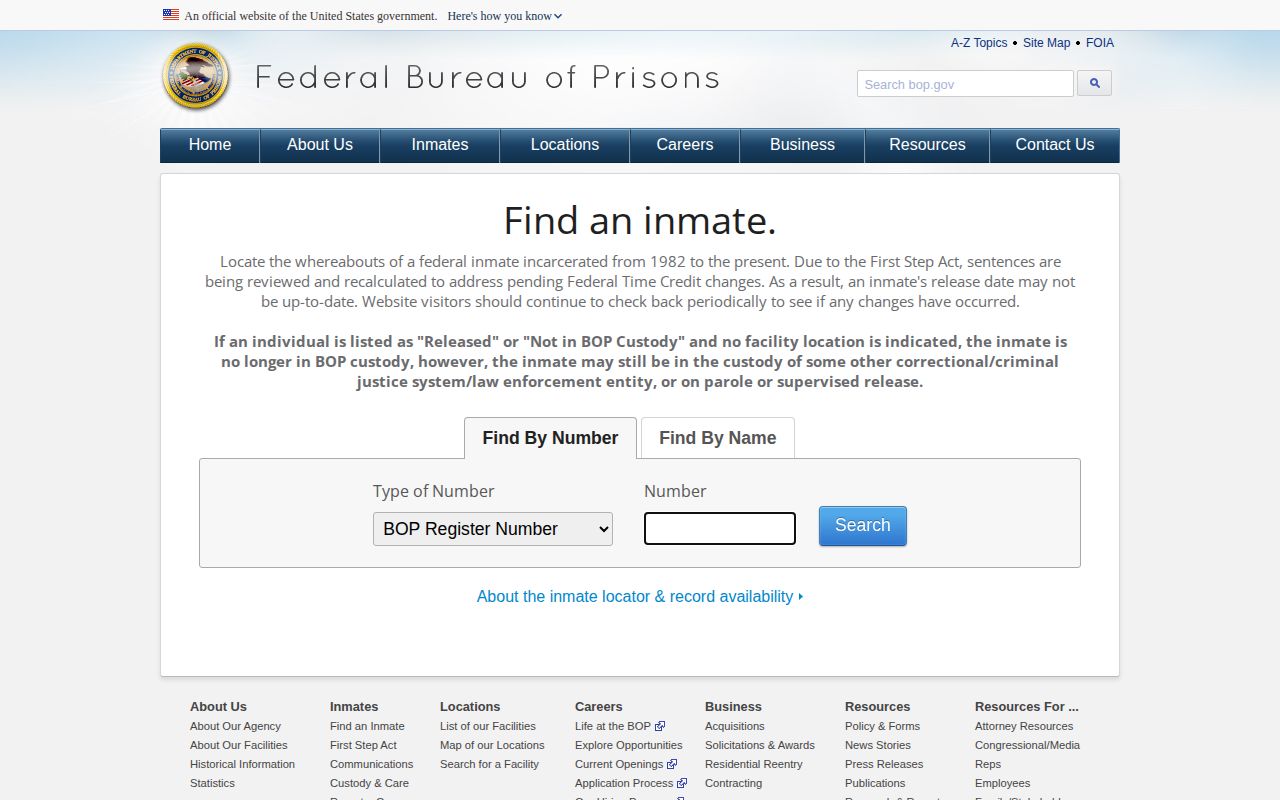
The displayed fields must be read as federal custody information, not as proof that every other hold ended.
- Use the register number for the most precise public match.
- Otherwise search the full name and apply only supported filters.
- Compare name, register number, age, race, and sex.
- Read the release date and location or status together.
- If the result says released or not in BOP custody, check any known receiving system.
BOP says locator information is extracted from its main database and updated daily. A future release date may change through sentence or credit calculations. Confirmation comes from the later status and location change, not from assuming a projected date passed as planned.
Federal BOP Result Fields
The federal locator provides a defined set of public fields. Each helps establish identity or interpret the custody status. Names alone are not enough when several people share one. Record the result exactly and avoid mixing a BOP register number with a SWVRJA booking number or VADOC DOC ID.
| Field | What it establishes |
|---|---|
| Name and register number | Identify the federal record. |
| Age, race, and sex | Help distinguish similar names. |
| Release date | Shows the federal date supplied by BOP. |
| Location or status | Shows a facility or the end of BOP custody. |
Pre-1982 federal history may require the archival route described by BOP. A no-result search is not proof that the person had no federal case. Check the accepted identifier, spelling, date range, and other likely custody system before reaching a conclusion.
Note: BOP's daily update cadence is different from SWVRJA's current-only tool and ICE's limited released-person window.
Federal BOP Records Requests
The BOP FOIA page is the official route when the locator does not supply enough context. A request should reasonably describe the existing federal record and follow identity or authorization procedures. Ask for the custody record or releasable fields tied to the person and register number, including the recorded end of BOP custody and the release date.
Federal Bureau of Prisons
Fee and privacy rules can affect what is released. A public locator result and a full agency record serve different purposes. Preserve the exact status shown, then use the records process when a federal release date, transfer, or historical detail needs official support. For older records, follow the National Archives direction given by BOP rather than treating the online range as complete.
Scott County Federal Transfers
A person may appear in SWVRJA because of a Scott County matter while a federal writ or hold also exists. If the regional record names a federal receiving agency, describe the event as a transfer unless the record expressly says otherwise. The United States Marshals Service has no comparable public historical-release locator, and a fugitive page is not a custody archive.
Use the local SWVRJA final event for the end of the regional booking. Use the federal court or PACER docket for detention and release orders where applicable. Use BOP for federal prison custody and release status. These layers can overlap without contradiction. A court order may precede processing, and a person not in BOP custody can still be held by a local or state agency.
The Scott County release-record path explains how to start with the known booking and follow each receiving agency. Do not search every system without a factual link. Build the timeline from the booking, case number, federal identifier, dates, and named transfer destination.
Resolve Federal Release Conflicts
A BOP result saying “Not in BOP Custody” and a current SWVRJA result can both be correct. Each source speaks only for its own agency. The same is true when ICE or VADOC reports custody. Compare the timestamp and jurisdiction, then report the narrow fact each record establishes.
- BOP custody
- Federal imprisonment administered by the Bureau of Prisons.
- Federal supervised release
- Court-ordered supervision after federal imprisonment, outside prison custody.
- Writ
- A court order that can cause temporary movement for proceedings.
- Transfer
- A handoff between custodians rather than community release.
Future BOP dates can change after recalculation and credits. A later released status is stronger public evidence than the prospective date alone. For precise proof, request the underlying record and retain the result's date. The correct conclusion names the layer: released from BOP custody, transferred out of SWVRJA, or held by another agency.
Note: A federal prison release does not by itself establish the end of court-ordered supervised release.
Verify a Federal Release Record
Start with the strongest identifier. Match the BOP register number, not only the name. Save the release date and status exactly as displayed, along with the check date. If another custodian is possible, search that official system using its own identifier. Ask BOP for records when the public result lacks the detail needed to explain a transition.
For a person formerly held by SWVRJA, request the local final custody event and receiving agency. That entry connects the Scott County side of the timeline to federal custody. The federal docket can explain the order, while BOP supplies the prison layer. None of these sources alone should be made to prove facts outside its scope.
A defensible statement is concise: BOP reports the named person released or not in BOP custody as of the checked result; another named agency reports current custody if applicable. That wording preserves both records and avoids treating one database boundary as the end of all legal authority.
BOP records can clarify a result that lacks transition detail. Ask for an existing record tied to the register number, not a new account of every possible custodian. If the federal record ends while another official locator begins, retain both dates and describe the handoff without speculation. Pre-1982 custody calls for the archival path rather than a conclusion from the modern locator.
A federal release date also should be distinguished from the end of supervised release. BOP operates the prison locator, while the sentencing court governs the supervision order. If the question concerns the later end of supervision, consult the correct federal court record rather than assuming the BOP release date ended every federal obligation.
When identity is uncertain, avoid forcing a match from name alone. Compare the register number and the public demographic fields, then check the relevant federal docket. A precise match makes the later records request narrower and reduces the risk of attaching a released status to the wrong person.