
Virginia DOC Release Paths
No VADOC prison was identified inside Scott County. The state system still matters when a Scott County defendant receives a state-responsible sentence and moves from SWVRJA into a Virginia prison. Leaving a prison may begin probation or parole in the community, while final discharge from VADOC authority can occur later. Those are separate dates and records.
A prison location means confinement continues. A probation or parole district result can show that incarceration has ended while supervision remains active. A fully inactive person may no longer be promised in the public locator. State release must not be described as a Duffield release, and a transfer from SWVRJA to VADOC is not community release.
Search Virginia DOC Releases
Use the VADOC Inmate and Supervisee Locator for the public first check. Search with at least the first three letters of the first name plus the full last name, or use the seven-digit DOC ID. Optional location, race, gender, and age filters can separate similar records. Accept the disclaimer and complete the current CAPTCHA.
The official VADOC search screen shows the statewide starting point.
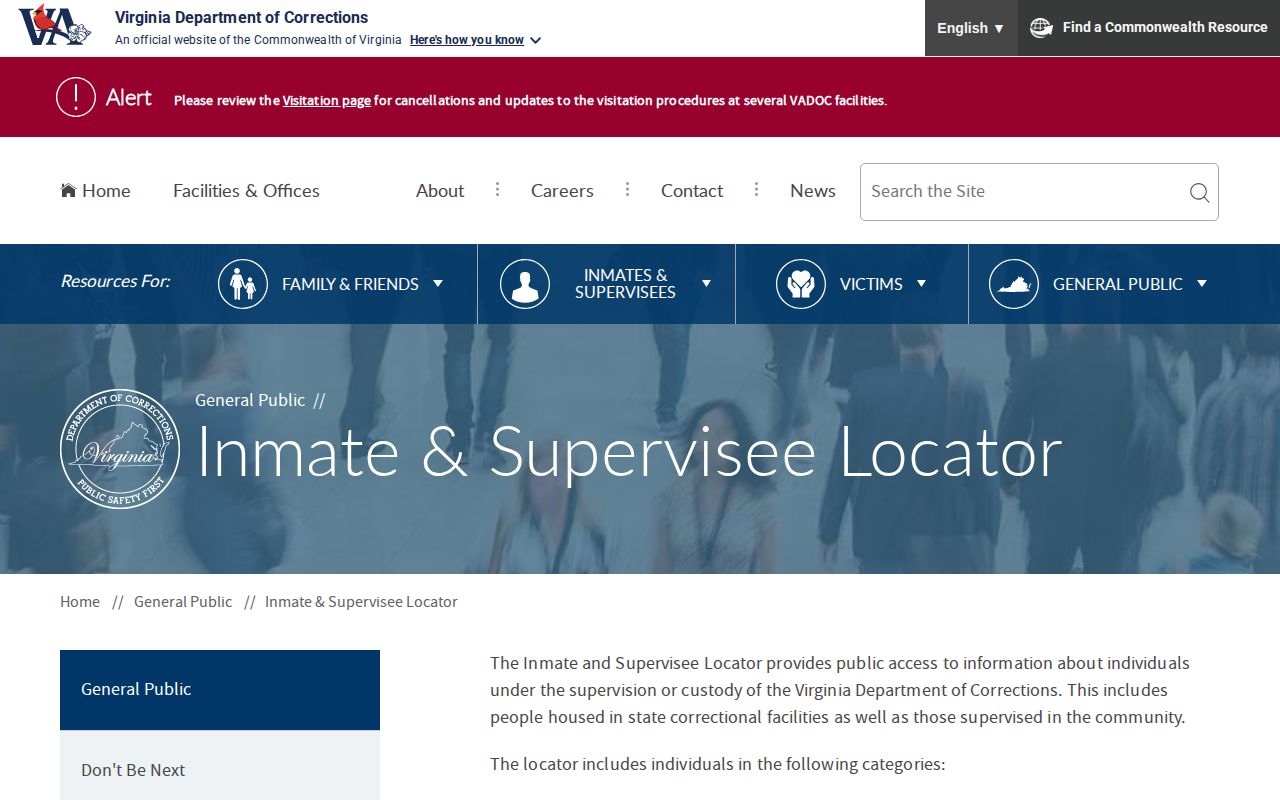
The form supports the name and DOC ID routes used to separate state custody from community supervision.
- Match the result by name and DOC ID.
- Read whether the location is a prison, local or regional jail under state authority, CCAP, or a supervision district.
- Record the status, location, and release-date field exactly as the live result labels them.
- For a fully inactive case, use Form 050_F17 or a focused VADOC records request.
- Ask for both actual prison release and final supervision discharge when both matter.
VADOC says locator data update daily and may be inaccurate or out of date. It is not a real-time door-out report. The Scott County custody search helps identify whether the starting record belongs to SWVRJA or VADOC.
Virginia DOC Locator Fields
The locator covers people in VADOC institutions, probationers and parolees supervised through district offices, people assigned to institutional hospitals, some people in local or regional jails under VADOC authority, and CCAP participants. It is a current relationship locator rather than a complete historical list of every person once held by Virginia.
| Search or result field | Use |
|---|---|
| First and last name | Starts a public name search. |
| Seven-digit DOC ID | Provides the strongest public match. |
| Optional filters | Separate people with similar names. |
| Status and location | Distinguish prison, jail, program, or community supervision. |
| Displayed date | Must be copied with the portal's exact current label. |
The research could not verify the exact live release-date label because CAPTCHA blocked a result inspection. Do not rename it “projected,” “estimated,” or “actual” without reading the current result. A future date can change, and a supervision location is not full discharge.
Virginia DOC Records Contact
For a complete release or discharge record, use VADOC's records channels. The public locator may stop covering a fully inactive case. Form 050_F17 is titled Request for Inactive Inmate or CCAP Probationer/Parolee Records and uses a secure identity and notarization process. Sensitive identifiers belong on that official form, not in public copy.
Virginia Department of Corrections
P.O. Box 26963
Richmond, VA 23261
Phone: 804-674-3000
Email: docmail@vadoc.virginia.gov
VADOC FOIA
Email: FOIA@vadoc.virginia.gov
Phone: 804-963-2953
Ask for the existing record or nonexempt fields showing actual release from incarceration, release type, whether community supervision followed, and final discharge date if any. Correctional and supervision records can be discretionary under Virginia law, so the request is not a promise that every field will be released.
Note: Form 050_F17 requests private identity data and a notarized signature, which should be sent only through the official process.
Scott County State Transfers
A Scott County defendant may remain in a regional jail for a time under VADOC authority before moving to a state institution elsewhere in Virginia. The SWVRJA event shows the local transfer. The VADOC locator then shows the state layer. No state prison was identified in Scott County, so the page concerns a statewide correctional network rather than a local jail building.
Match the SWVRJA booking number, court case, and VADOC DOC ID where each is available. The Scott court sentencing order establishes the sentence, but it is not the actual prison release record. VADOC time computation accounts for sentence type, total sentence, jail time served, credit track, classification, discipline, and other events. A projected date is therefore not proof that the person left on that date.
After a prison exit, District 18 may appear as the supervision location for Scott County. That supports release from incarceration into community supervision. It does not mean supervision has ended. Contact the published district office only for its appropriate current role and recognize that staff may limit disclosure.
Virginia DOC Release Evidence
Different state sources prove different facts. The locator is the public current check. VADOC's actual release record is primary for the physical end of prison custody. A Virginia Parole Board report documents a Board decision but not necessarily the walk-out date. A court order supplies the judicial sentence rather than the later correctional computation.
- State custody
- Confinement or authority administered by VADOC.
- Supervision
- Probation or parole in the community under VADOC authority.
- Actual release
- The recorded end of incarceration.
- Discharge
- The end of the agency's remaining authority or supervision.
A no-result search is weak evidence. It can reflect a spelling problem, local-only custody, federal custody, data timing, or a completed inactive case. Use the inactive-record route rather than claiming the person was never in VADOC. When sources conflict, compare dates and scope before asking the agency for the underlying record.
Virginia DOC Release Calculation
VADOC calculates dates for qualifying active state sentences. Virginia earned-credit law has different tracks, offense-date rules, classifications, and forfeiture provisions. The common “serve 85 percent” phrase is not a safe universal calculator. Mandatory minimums, suspended time, jail credit, discipline, multiple sentences, and later court action can change the result.
The official time-computation page explains the agency's role. A displayed future date remains prospective. Confirm the later location or status change and obtain the actual release record when precision matters. A parole grant also requires processing before physical release and should not be substituted for the final custody event.
For a local sentence of twelve months or less, the regional jail and its written credit policy remain central. That calculation should not replace the VADOC state-sentence computation. Ask SWVRJA for the operative local policy and the actual local calculation when the sentence stayed regional. If it moved into the state system, rely on VADOC computation and distinguish earned credits from the later actual release event.
Note: Cite the Virginia law effective on the relevant date because earned-credit and parole provisions can change over time.
VADOC also has authority under Virginia law to discharge a state prisoner within a limited period before the term would otherwise expire for prerelease programming. That authority does not make a projected public date a guaranteed exit day. Read the later state record to learn when incarceration actually ended, then determine whether a supervision district became the next status.
When requesting an inactive record, identify the prior DOC number if known and state the fields needed. Ask separately for the actual incarceration release, release type, supervision start, and final discharge. This prevents one date from being used as though it answered all four questions and gives VADOC a focused description of existing records.