
Scott County Projected Versus Actual Release
A projected or calculated release date is a future estimate produced from the sentence information and credits assigned to the proper custodian. An actual release date records an event that has already happened. These dates can differ because the calculation may change, another hold may prevent departure, a court may alter the sentence, or the person may transfer to a new custodian.
Pretrial custody follows a different path. A person held before final judgment has no fixed sentence-end date. Bond may authorize release, but staff still must process the order and check for other cases or holds. A dismissal in one Scott County case can coexist with another valid basis for custody. The SWVRJA final custody event, not a court entry alone, shows when local custody ended and whether the person left for the community or another agency.
Scheduled is not actual. A future date helps with planning, while the later jail or VADOC record confirms the real release or transfer.
| Date | What it means | Best source |
|---|---|---|
| Court order date | When the judge entered an order | Scott court case |
| Calculated release date | The custodian's future sentence computation | VADOC or SWVRJA record |
| Actual release time | When custody ended in that system | Final custody-event record |
| Supervision start | When parole or probation begins in the community | VADOC supervision record |
| Final discharge | When the correctional relationship ends | VADOC inactive or discharge record |
Find a Scott County Release Date
Classify the sentence before searching. VADOC calculates dates for active Earned Sentence Credit sentences over twelve months. It also calculates discretionary-parole eligibility, mandatory-parole release, and good-time release dates when qualifying active parole-eligible sentences total more than twelve months. Local authorities remain central for shorter or local sentences.
- Read the Scott court sentencing order and identify active time, suspended time, jail credit, and any mandatory minimum.
- Determine whether SWVRJA or VADOC is responsible for the current computation.
- For a state-responsible sentence, search the VADOC locator by seven-digit DOC ID when possible.
- Record the exact status, location, and release-date wording shown on the individual result.
- For a local sentence, request SWVRJA's actual computation and operative written credit policy.
- Check again after the projected date and request the actual release or transfer event if precision matters.
A person may remain physically in a regional jail while under VADOC authority. “In regional jail” and “state responsible” are therefore not mutually exclusive. The sentence and authority determine who computes the date. The complete Scott County released-inmate search path can be used after the expected date to trace the final event.
Note: Use the sentencing order and custody authority together because the person's physical building does not always identify the calculating agency.
Scott County VADOC Release-Date Search
The VADOC Inmate and Supervisee Locator covers state institutions, probation and parole districts, institutional hospitals, some people in local or regional jails under VADOC authority, and CCAP participants. Search with at least the first three letters of the first name and the full last name, or use the seven-digit DOC ID. Optional location, race, gender, and age filters can help distinguish matches.
Accept the disclaimer and complete the CAPTCHA. Then copy the DOC ID, exact status, exact location, and the date wording as displayed. Research could confirm that the official tool offers release-date information, but CAPTCHA blocked inspection of a live result. It would be inaccurate to invent whether the current label says “release,” “estimated,” “projected,” or another term. Preserve the live wording.
VADOC says the locator updates daily and may be inaccurate or out of date. A prison or jail location means custody continues. A probation or parole district can support release from incarceration into active community supervision. It does not show full discharge. A missing result can reflect a spelling issue, local-only custody, another system, timing, or an inactive case.
The official VADOC locator page can be reviewed before entering identity details.
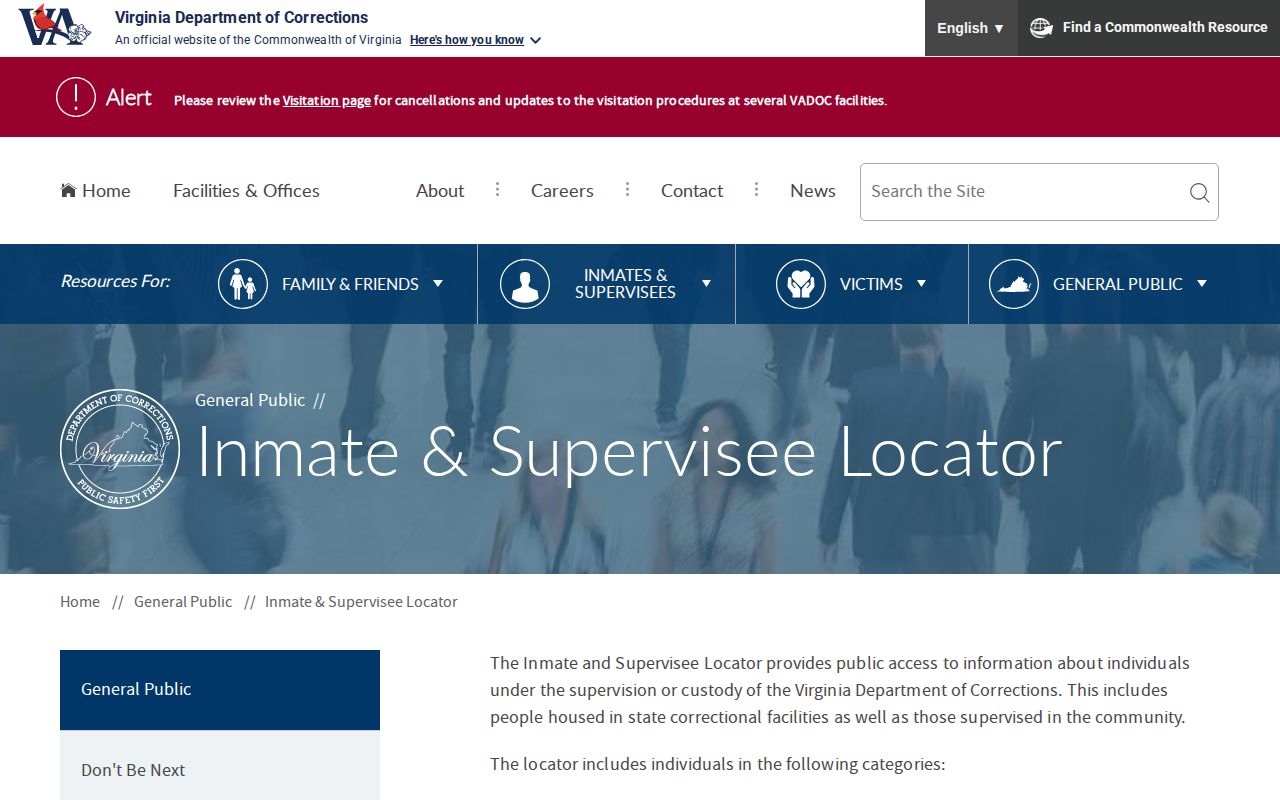
The captured search form supports the state lookup route, while the individual result supplies the status and date that must be read verbatim.
Scott County State Release Credits
Virginia Code § 53.1-202.2 governs felony earned-credit eligibility for offenses committed on or after January 1, 1995. One earned sentence credit equals one day deducted from the term. Effective dates matter. The current 2026 provision and a scheduled July 1, 2028 version differ, so future text should not be quoted as present law.
§ 53.1-202.3 establishes two practical tracks. Enumerated subsection-A offenses can earn no more than 4.5 days for each 30 days served. Other eligible offenses use four levels: Level I provides 15 days for each 30 served, Level II provides 7.5, Level III provides 3.5, and Level IV provides none. Classification depends on statutory and program criteria, is reviewed, and may change. § 53.1-202.4 addresses classification criteria and forfeiture.
The common “serve about 85 percent” phrase is historical shorthand, not a safe calculator. Even the 4.5-per-30 rate should be stated as a statutory maximum for its track. Offense, offense date, credit track, class level, jail credit, discipline, mandatory minimums, and sentence orders can change the outcome. Do not multiply a sentence by a fixed percentage and call the answer definitive.
VADOC's Time Computation page identifies jail time served, sentence type, total sentence, credit class, discipline, and later events as calculation factors. The official explanation is shown below.
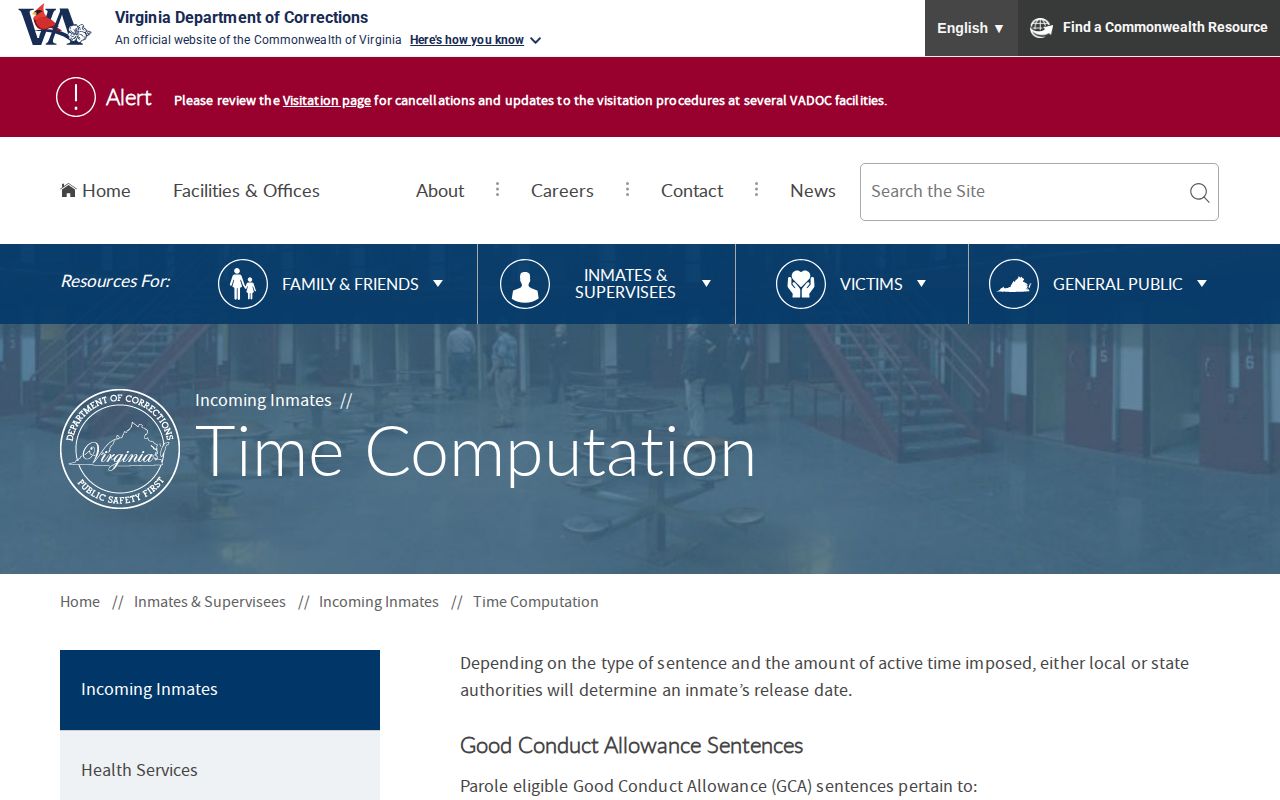
The source demonstrates why the VADOC result and official computation should control instead of a home-made percentage estimate.
Scott County Local Release Computation
A Scott County local sentence is not calculated through the state future-date field unless VADOC has authority and responsibility for that sentence. For a locally calculated term, obtain the sentencing order. Note the imposed term, suspended portion, credit for time served, mandatory minimum, and any other commitment. Then ask SWVRJA for the actual computation rather than testing hypothetical arithmetic.
Virginia Code § 53.1-116 says that, unless serving a mandatory minimum, a person sentenced to twelve months or less for misdemeanors earns one day of good-conduct credit for each compliant day served. The law includes rules for other categories and added qualifying activity. It also requires a written facility credit policy. Rule compliance, credit classification, and separate commitments can affect the result.
A “time served” order must also be kept distinct from the jail event. The order may authorize release in that case while another warrant or hold continues custody. Ask whether the person actually left SWVRJA and at what time, or which agency received the person. If a projected local date falls on a weekend or holiday, request the operative policy. No official Scott-specific early-release scheduling rule was verified.
Do not import state rules into a local case. VADOC early-discharge authority and state earned-credit tracks do not automatically govern an SWVRJA sentence.
Why Scott County Release Dates Change
A projected date moves when the inputs or legal basis change. Some changes affect sentence length. Others leave the calculation intact but prevent a person from returning to the community. The record should state which kind of event occurred.
| Factor | Possible effect | Source to check |
|---|---|---|
| Earned-credit class | A different current rate changes the calculated date | VADOC computation |
| Discipline or forfeiture | Loss of credit can move the date later | Custodian's computation record |
| Pretrial jail credit | Verified prior time can affect the remaining term | Sentencing order and computation |
| Mandatory minimum | Limits credits or early release as the law provides | Sentence and governing statute |
| New or corrected court order | Changes active or suspended time | Scott court record |
| Detainer or warrant | May cause transfer or continued custody after one term ends | Final custody event and receiving agency |
| Parole action | May authorize release after processing, or leave custody unchanged | Parole Board and VADOC records |
A parole grant deserves special care. The Board action authorizes parole but does not necessarily state the physical exit date. VADOC can continue to show a prison during release planning. Conversely, a monthly Board report may post after an operational event. Use the Board record for the decision and VADOC for custody.
Multiple sentences can also interact. One term may appear complete while another remains active, and a credit may apply differently across commitments. A corrected order or verified jail-credit entry can change the agency calculation without any new conviction. The useful question is not simply whether a number moved, but which source changed an input and when that change became part of the official computation.
Note: A hold can end one agency's custody while beginning another's, so the expected community date may not occur.
Scott County State Discharge Window
Virginia Code § 53.1-28 authorizes the VADOC Director, for prerelease programming, to discharge a state prisoner on a day within thirty days before the term would normally expire. The section also addresses documents supplied on discharge. This is state-prison authority, not an automatic promise that each person will leave on the earliest day in that window.
The public projected date remains a planning field. It does not identify whether this authority will be used, which day VADOC will select, or whether another legal barrier exists. Confirm the later state status and request the actual release record when the exact event matters. Do not apply the provision to an SWVRJA regional-jail sentence without legal support.
Confirm Scott County Actual Release
Check again after the expected date. For state custody, read whether VADOC still lists a prison, a regional jail under state authority, or a community-supervision district. A district location can support that incarceration has ended and supervision has begun. For full discharge, use the inactive-record route or a focused request for the actual release and discharge dates.
VADOC Form 050_F17 is the documented inactive-record route for an inmate or CCAP probationer/parolee record. It calls for sensitive identity details, a signature, and notarization. Those fields belong in the secure agency process, not public copy. Authorization and correctional-record limits still apply.
For SWVRJA, ask for the final custody event, including date and time, release or transfer disposition, reason, and receiving agency. Compare it with the Scott court order. If VINE supplied a status alert, treat it as corroboration. The Scott County VINELink release check explains how to register and why a local-jail alert must be verified.
If sources seem to conflict, compare their timestamp and scope. A court order can precede jail processing. A yesterday VADOC result can coexist with today's release record. A SWVRJA release and VADOC admission can describe one transfer. Use precise terms such as calculated release date, actual release time, transfer time, supervision start, and final discharge.
Keep each date label tied to the agency that issued it.