
Scott County VINELink Custody Coverage
VINELink is the public access point for Virginia Jail VINE. The local-jail layer includes Southwest Virginia Regional Jail Authority, which runs the Duffield, Abingdon, Haysi, and Tazewell facilities. It is a person-specific custody and notification tool, not a Scott County release archive. A reader searches for one person and then registers on that matched record.
Coverage follows the reporting jail. A current SWVRJA match can show the facility and custody label that VINE received. A released label shows that the participating jail reported a custody change. It does not independently tell whether the person walked into the community, moved to another SWVRJA site, entered VADOC custody, or went to another agency. SWVRJA's final custody-event record is the closest source for that distinction.
Virginia has two custody layers. Virginia Jail VINE covers local jails. VADOC prison notifications use NAAVI for eligible registrants, and enrollment does not transfer automatically.
The official SWVRJA Virginia VINE page confirms the local service and gives 800-467-4943. Its captured page shows that Scott County local-jail alerts start with the regional authority's VINE route.
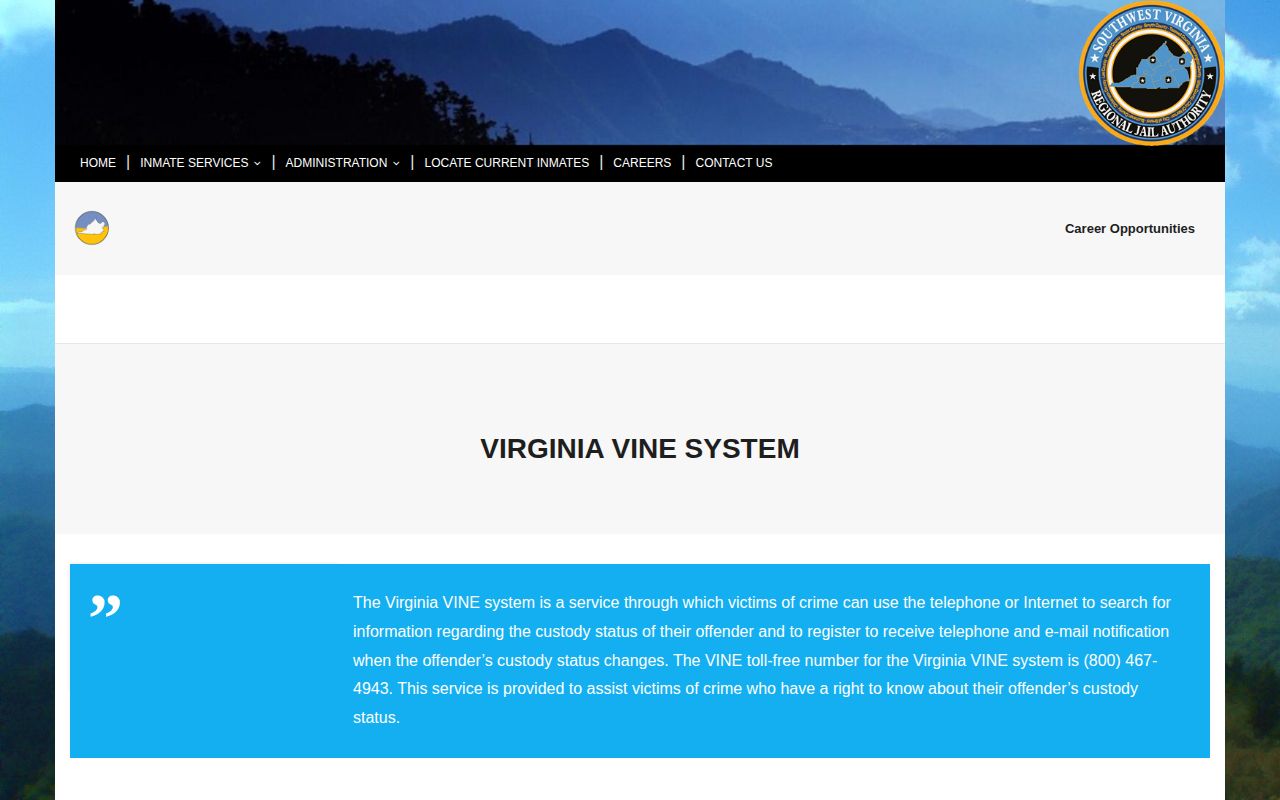
The local page is the right starting point for an SWVRJA booking, but state-prison and federal cases require different systems.
Search a Scott County Inmate
Start with exact first and last name. When possible, retain the booking or offender identifier from a legitimate prior record. Age can help separate two matching names if the current interface shows it. Do not select a person on name alone when the results contain more than one reasonable match.
- Open VINELink and select Virginia and the local-jail custody search.
- Enter the exact first and last name. Use the available booking or offender identifier to narrow the match.
- Compare age and other public identity details only as the interface permits.
- Open the matching record and read the named facility and exact custody label.
- Record the observation time. Dynamic status can change after the search.
A Scott County arrest is usually searched authority-wide because SWVRJA is a four-facility system. A person absent from a Duffield assumption may be held at Abingdon, Haysi, or Tazewell. If the person is absent from VINE, check the SWVRJA current-inmate locator. Absence from both public tools remains weak evidence. It does not establish a release.
For a broader named-person custody chain, the Scott County released-inmate search explains how to pair the jail event with the court docket and the correct receiving system.
Note: Record the exact facility and status wording because a later change can explain a transfer boundary or release report.
Scott County VINELink Release Fields
VINELink fields should be read as reported notification data. They do not form a certified history. The most useful items identify the record, say which jail supplied it, and show the current custody label. An available registration option confirms only that notifications can be requested for that record.
| Field | What it establishes | What it does not establish |
|---|---|---|
| Name | The name attached to the VINE record | Identity without comparison to another identifier |
| Booking or offender ID | A way to distinguish records when displayed | A complete court or jail history |
| Facility | The reporting custody site or agency | Where the person went after a later transfer |
| Custody status | The exact status supplied to VINE | Certified community release versus transfer |
| Notification option | Channels currently offered for that record | Guaranteed delivery or coverage in another system |
VINE is strongest as timely corroboration. If it says released, ask SWVRJA for the final event date and time, release-versus-transfer disposition, and destination agency where recorded. If the record says the person remains in custody, that is the current reported status, subject to data timing and correction.
Can a VINE release alert prove freedom? No. One agency can report release at the same moment another accepts custody. Both statements can be correct within their own jurisdiction.
Register Scott County Release Alerts
Registration takes place on the matched person's record. Use only the telephone, email, or other channel the live interface currently offers. The phone workflow includes a personal identification number, or PIN. The PIN acknowledges that the automated call reached the registered person and stops repeat calls after the notice is heard. It does not certify the underlying custody detail.
- Choose the notification option on the matched Virginia Jail VINE record.
- Select telephone, email, or another channel that the current screen offers.
- Enter the destination carefully and create the telephone PIN when prompted.
- Submit the registration and keep the confirmation in a secure place.
- When an automated phone notice arrives, enter the PIN to acknowledge it and stop repeat calls.
Do not place notification addresses, PINs, or private credentials in a public note or screenshot. Contact failures and delays can occur. An urgently important change should be checked directly with SWVRJA rather than waiting on another automated call.
The Virginia Jail VINE search is the live place to review the channels offered at registration. The captured search page represents the one-person entry point without using a current person as a released example.
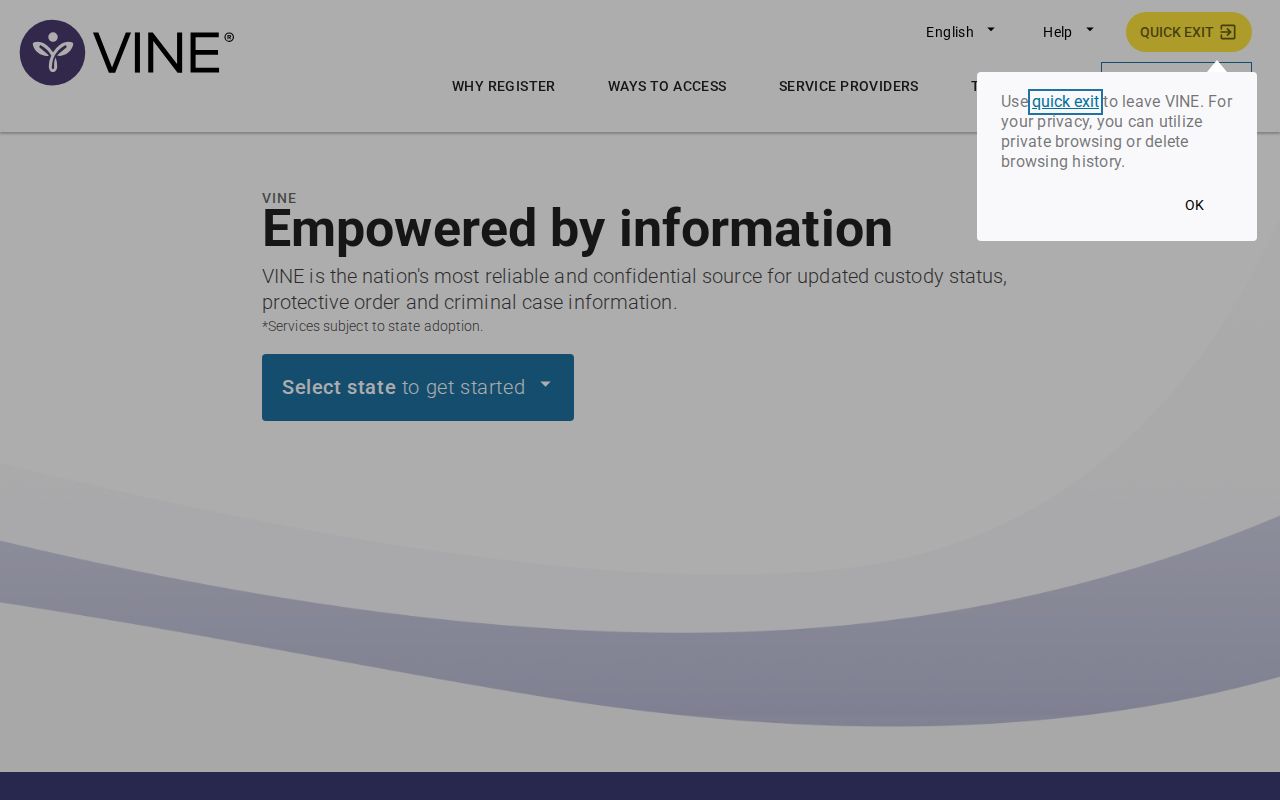
The interface can change, so follow its present prompts while keeping the identity match and confirmation record.
Scott County VINE and NAAVI Split
This separate-registration rule is a central Scott County release issue. A person can leave SWVRJA for VADOC without entering the community. The local jail may then report an event through Virginia Jail VINE, but the original registration does not continue into the state prison system. An eligible registrant must use the VADOC/NAAVI process for state-custody notices.
The NAAVI FAQ states that VINE does not provide information or notification about VADOC inmates. NAAVI may provide eligible victims notice of permanent transfer, advance release, a changed advance-release date, and actual release. VADOC says an actual-release notice means the person is no longer in VADOC custody and those state notices stop. Eligibility is limited, so NAAVI is not a general public alert service.
A third notification layer, the Virginia Sex Offender and Crimes Against Minors Registry, concerns people with a legal registration duty. It is not a local-jail or VADOC release alert. The systems answer different questions and do not share enrollment.
Note: A Scott County jail alert must be re-registered through NAAVI when an eligible person needs VADOC state-custody notifications.
Confirm Scott County VINELink Releases
The Virginia VINE workflow warns that an apparent release should be checked to learn whether it was an actual community release or a transfer to another jail. For SWVRJA, ask for the existing last custody-event record. Identify the person, booking number when known, booking date, and narrow date range. Request the final event time, disposition or reason, and receiving agency if transferred.
Next, follow the destination. Search the VADOC Inmate and Supervisee Locator if the case involved a state sentence. It accepts a seven-digit DOC ID or permitted name fields and can show a prison, regional jail under state authority, CCAP, or community-supervision district. VADOC says the data update daily and may be out of date. A district result supports release from incarceration into supervision, not full discharge.
Review the Scott court case for the legal reason, such as bond, dismissal, or a sentence order. A court event does not give the jail's final processing time and may coexist with another hold. State the evidence in layers: VINE reported a custody change; SWVRJA identified the event; the court supplied the related order.
When VINE says released but no agency result seems to show the person, begin with the precise VINE system and the time of the alert. A Virginia Jail VINE event concerns local-jail reporting. Search all four SWVRJA facilities, not just Duffield. If the person received a state sentence, search VADOC next because the local release may have been the state intake boundary. Use BOP or ICE only when the case facts point to federal or immigration custody.
If no online source returns a match, build a narrow custody timeline. Use the known booking agency, booking date, court case number, sentence, and any likely transfer. Ask SWVRJA for the final custody event rather than asking staff to investigate the person's whereabouts. A response that the record cannot be found is different from a response withholding it under a legal exception. Preserve the distinction and request segregable, nonexempt fields when a record is partly withheld.
Identity matching remains essential during this conflict check. Compare an SWVRJA booking number, seven-digit DOC ID, federal register number, ICE A-number, or court case number as the relevant system permits. Names can change through aliases, suffixes, spelling, and data entry. Do not publish private alert destinations, telephone PINs, or sensitive identifiers just because a secure agency form asks for them.
Scott County Release Alert Limits
VINELink does not cover every custody system. It is not the federal BOP locator, ICE ODLS, a court docket, or an archival release record. A federal status must be checked in the BOP system. An immigration status must be checked in ICE's system. A VADOC state-inmate alert belongs to NAAVI for an eligible registrant, not Virginia Jail VINE.
Notification data can lag, be corrected, or fail to reach a contact channel. A release label is jurisdiction-limited. A no-result response may mean a spelling mismatch, a local-to-state transfer, a fully inactive case, a different custody system, or data timing. It should never be stretched into proof that the person is free.
The alert time and the custody-event time may also differ. Preserve both rather than converting the phone or email delivery time into an official release time. If a correction follows the first alert, keep the later notice and ask the reporting agency which event is reflected in its final record.
Use the originating record for final proof. VINELink supplies timely notice; SWVRJA, VADOC, BOP, or ICE supplies the custody event for its own system.
For safety-critical or legally precise questions, direct agency confirmation is the final step. Keep dates and source labels exact. “Released from SWVRJA,” “released from VADOC,” and “not in BOP custody” are not interchangeable claims.